

I have blogged in the past about using word families to help emergent readers and writers to develop their phonemic awareness. Phonemic awareness is one of the important strands in literacy that emergent literacy learners need to start developing (Scarborough, 2001). To support people to do this, I have developed a bunch of resources to print and use – and, more recently, an app, Word Families for Phonemic Awareness.
Phonemic awareness is an important skill – it is the skill we use to hear sounds in speech. Without phonemic awareness (PA), we cannot break words down and decode them to read unfamiliar words. We also find it extremely hard to re-code words to spell them. Therefore, PA is a critical skill in learning to read and write.
PA starts developing when students are emergent and continues once they are conventional. Word families have been shown to be an effective way to improve phonemic awareness, particularly the ability to hear initial sounds in words. Doing some short word family activities regularly with emergent literacy learners can help them to start to hear sounds in speech – which, in turn, helps them to learn to work with words later in their literacy development.
It is important to note that for neurotypical children, letter name knowledge and the ability to hear at least initial sounds in words were found to be crucial foundational skills for participating in phonics instruction. Without them, children learned phonics tasks in isolation but didn’t transfer the skills being taught (see Byrne 2005 for a summary of this research).
Generally, we don’t start these activities until a student knows at least 50% of the alphabet. This is based on research showing that there is a strong association between a student’s letter knowledge and their phonemic awareness (e.g., Castles & Coltheart, 2004; Castles, Coltheart, Wilson, Valpied, & Wedgwood, 2009; Hulme, Bowyer-Crane, Carroll, Duff, & Snowling, 2012). Where possible, use letters the student already knows in these tasks to assist with building this association.
This new app, Word Families for Phonemic Awareness, provides some activities for working on phonemic awareness. The word family activities can be used to develop phonemic awareness using initial sounds in word families across a number of weeks. Students should also participate in other tasks designed to improve their phonemic awareness.
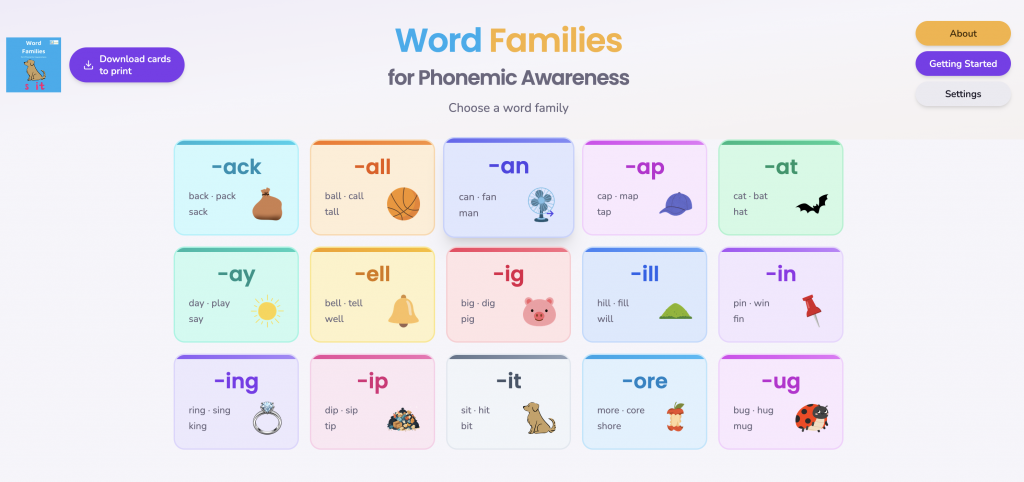
Word Families for Phonemic Awareness
The activities in this app are designed to support gradual release of responsibility (Pearson & Gallagher, 1983) in targeting phonemic awareness. Gradual Release of Responsibility is often called “I do, We do and You do”. It is a model that provides scaffolds for learning through modeling, guided practice, and independent tasks. Over time, it enables students to become independent learners. It also reduces the cognitive load of learning new information as the teacher gradually shares more of that load with the students.
Using Word Families for Phonemic Awareness with Gradual Release of Responsibility
I suggest that you use a single word family across a week and then move to a new word family the following week. On Monday, Tuesday and Wednesday you should do I do and We Do tasks. On Thursday and Friday, you can move to You Do tasks, although if the student struggles with the You Do tasks, you can turn them into We Do tasks.
I Do and We Do Tasks
Within the Word Families for Phonemic Awareness app, the Books to Read and the Interactive Word Family Activities within each word family are designed as I do and We do tasks.
Books to Read
There are three books provided for each word family. Once a book has been selected, the educator should read the book and model making the word family word on each page of the book. All the relevant single letters for the word family are available on each page. It is great to model the “right” word for the page, but this is also a time where the teacher and student can stop and play with the word family on any page, discovering how the different sounds change the word. This can be used as an I do or a We do task.
Please note: only single letter beginning sounds are provided for the word family words, to support students in developing their phonemic awareness. Two letter sounds, like th or sh, are deliberately not used within this app as they add a level of complexity to listening to the sounds changing at the beginning of words.
Interactive Word Family Activities
There are three options in this section for each word family – again providing options for I do and We do tasks. There is deliberately no “right” or “wrong” within these activities, so they provide a safe place to experiment with the word family and discover the change that each different initial sound makes.
Select Pictures and Select Letters are designed as standalone activitiies. Letters Only can be used in conjunction with another task e.g. a word family book on Monarch Reader.
You Do Tasks
Word Family Activity
The Word Family Activity in each word family provides a You Do task. The teacher or student can decide how many letters the student will be picking from during the task – and then the student needs to look at the picture, listen to the word for the picture and then select the correct initial sound. Feedback is provided if needed. The activity goes through all words in the word family in random order.
If a student is struggling with this as a You Do task, then go back to the We Do tasks or convert this activity to a We Do task, providing the student with extra support. You can also try reducing the number of letters that the student is choosing between.
Non-electronic Options
If you would prefer to do work families for phonemic awareness using non-electronic resources, you can download a bunch of cards with letters and pictures from the home page of the app. You can also download each book within the app as a PDF and then print it and use it.
Word Families for Phonemic Awareness 10 week Program
I’ve also written an example 10 week program for using Word Families to improve Phonemic Awareness. You can download this from the Getting Started section in the app – or you can download it below. This program includes a plan for the 10 weeks and a record form for the You Do activities.
Have fun with Word Families!
