

I have blogged a lot about emergent writers and helping students to develop their writing skills. My two favourite posts about emergent writing are Emergent Writing: Focus on Function and Emergent Writing: Moving onto Form. Additionally, I have developed (with lots of help) the Writing with All Tools Continuum, a 35-point ordinal scale consisting of qualitative writing levels from early emergent to conventional writing, up to Australian Curriculum Grade 4. As I’m working with schools and in classrooms, I often work with students who are no longer emergent writers, and who need us to support their conventional writing development. I haven’t blogged about this as much – so this is the first of three blog posts about some new conventional writing supports for teachers that I’ve been working on.
Once a student is at Group D or higher on the Writing with All Tools Continuum (WwATC), then we change the way we do writing with them. For these students, we need to do a writing mini-lesson before they write – modelling the level we want them to move to.
Students in Groups D, E and F are learning to write one good sentence independently. There are a lot of skills for them to learn to juggle every time they write, and we may need to model different skills repeatedly for many students to learn to include them in their writing “juggle”.
In this blog post, I’m sharing a group of Mini-Lesson cards, aimed at helping students in Groups D, E and F on the WwATC to move towards writing that one good sentence, independently.
Beginning writers often write about themselves, their interests and animals – so these cards focus heavily on
those areas. Many students also struggle with little words, including pronouns, and also with using a broader
range of describing and opinion words – so, again, these are the focus in some of the mini-lessons.
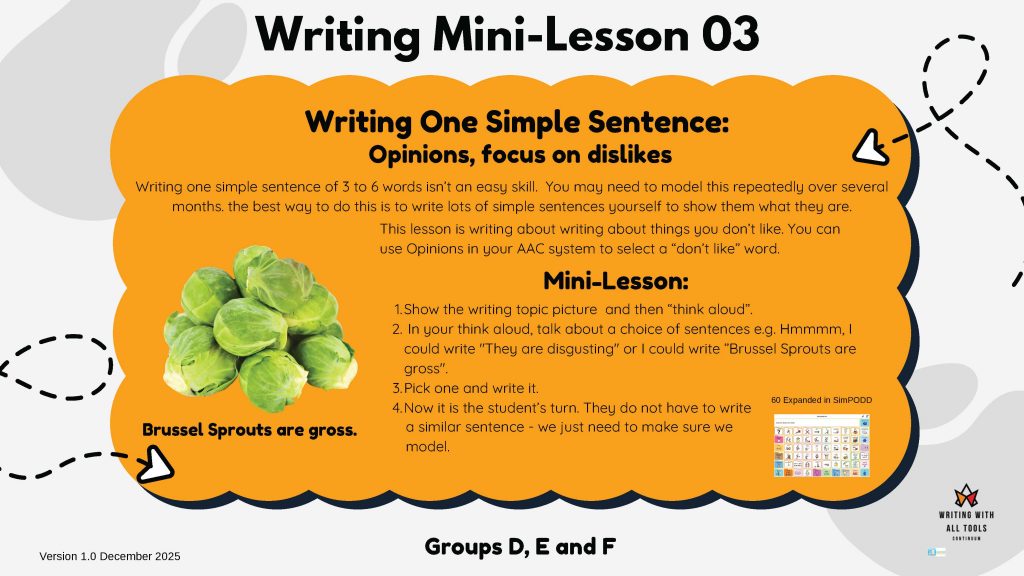
Additionally, for a student learning to write one good sentence we focus our mini- lessons on ideas, language
and spaces. We are not yet targeting end punctuation, or spelling, or capital letters. We still model them in our
mini lesson but these are not the focus of instruction just yet. Once the student has finished writing you can say“now let me show you how I would write it” and write their sentence again on the back of their writing or on a post-it
note. You would write it correctly, following all conventions, but this is the only intervention we do around
spelling, capitals and end punctuation at this stage. Students at this level should also be participating in phonics instruction and learning to read and write irregular words in the working with words block – and these skills will gradually move across to their writing. Just be aware that there is often a time lapse between a student being able to use these skills in the Working with Words block and the same skills appearing in their writing.
As well as the mini-lessons, there are three Addendums.
The first addendum is about scaffolds that we can use with students in Groups D, E and F. Co-construction is one of these scaffolds – and is a valuable tool for working together with students to build the language they need to write a complete sentence.
The second addendum is about Little Words. Many of the students I have worked with over the years, struggle to include Little Words in their writing. I have found that introducing them strategically and using them in context, as well as encouraging them to use them in their writing, works well. Below is some information I’ve pulled together about introducing and targeting Little Words.
The third addendum provides some additional suggestions for teaching students about sentences.
And finally, I’d like to thank the teachers I work with who have trialled these already and given me feedback – and supported me to improve them!
Happy writing everyone

toby
Jane