

Once a writer can write one or more simple sentences, then they need to learn to write more with coherence and cohesion, including writing expanded (longer) sentences. These are the skills we are working to teach students in Groups G & H on the Writing with All Tools Continuum.
When teaching students to write more, one of the common requests from the writing research is that we don’t make too many suggestions or give ideas when a student is at this stage, so that we don’t interfere with them becoming an autonomous writer. The suggested prompt that we use is “tell me more”. For years I struggled with this, as it seemed that many students then wrote more, but they often wrote a series of sentences like a list. There’s an example below.
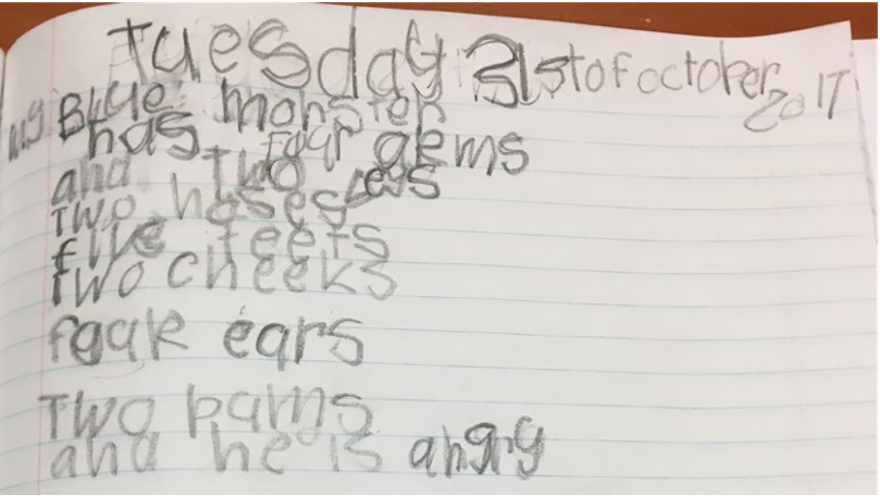
While struggling with this (due to my huge respect for the need for everyone to develop autonomy), I was reading yet another writing text – although this one was of a more practical nature. Writing Mini-Lessons for First Grade: The Four Blocks Model contained a serious gem, suggesting that instead of asking questions to direct students to add more, that instead we teach the students to ask themselves very general questions. Brilliant!
To explain further. Let’s imagine a student has just written “On the weekend we went to the shops.” They then pause for a long time, thinking. The usual adult reaction is to step in with a question. For example “what did you buy”. But the problem is that this question has just sent the student’s writing in the direction the adult thinks it should go in, instead of the direction that the student wanted to go in. In fact, the student was thinking how to write “dad hit another car in the car park” – but because the student thinks that they have to follow the adult’s suggestion their writing goes in a completely different direction and they lose their autonomy,
Instead the text suggests that we teach students 5 questions that they can use to prompt themselves when writing more. These are “who, what, when, where and why”. We don’t define these questions any further – but we start using them in our mini-lessons and we teach students that these are questions they can ask themselves to write more while adding more important information.
Of course, the 5w Questions aren’t the only options for teaching students to write more.
Writing Mini-Lesson Cards for Groups G & H
The writing mini-lesson cards for Groups G and H can be downloaded below. They start by focusing on teaching students to write expanded (longer) sentences and then move onto complex sentences. They cover introducing the 5ws and also introducing self-editing to students using an editor’s checklist. There are a much bigger group of these mini-lessons, thirty-seven of them to be exact, due to the range of skills covered. Not all students will need all mini-lessons – and sometimes a student will need the mini-lesson multiple times to learn to implement the skills.
Implementing using the 5ws in writing – who, what, when, where and why
Extra Documents to support teaching students to use the 5Ws
Teaching students to Edit
Extra documents to teaching self-editing
Different optons for representing the editor’s checklist:
Addendums
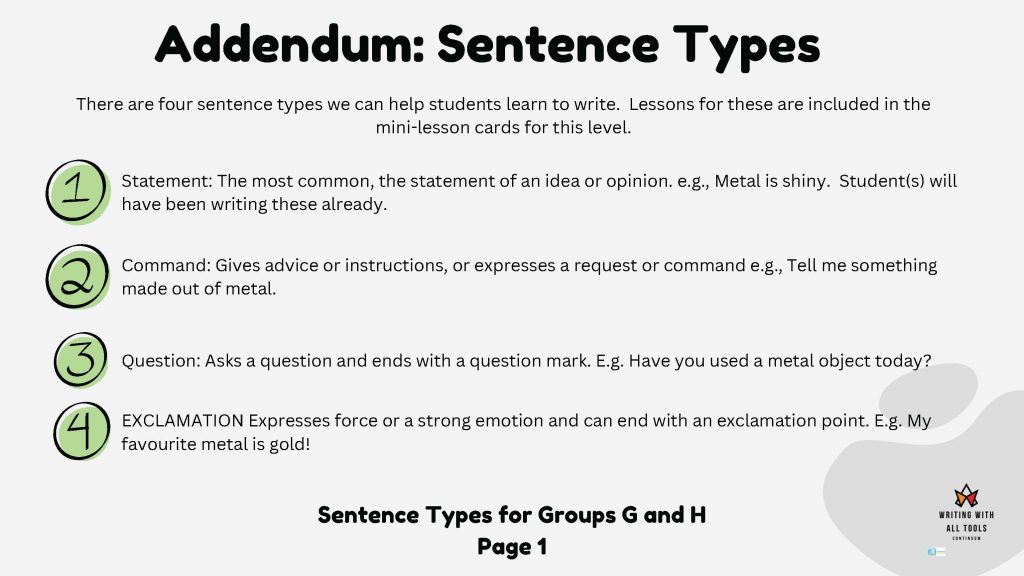
Please check out the addendums at the end of the mini-lesson cards as well. There’s informaiton on the 5ws, Editing, Topics, Sentence Types, and Author’s Chair.
And, as always, have fun writing!!

Karen Forrest
Jane
Karen Forrest